
 8573-999-666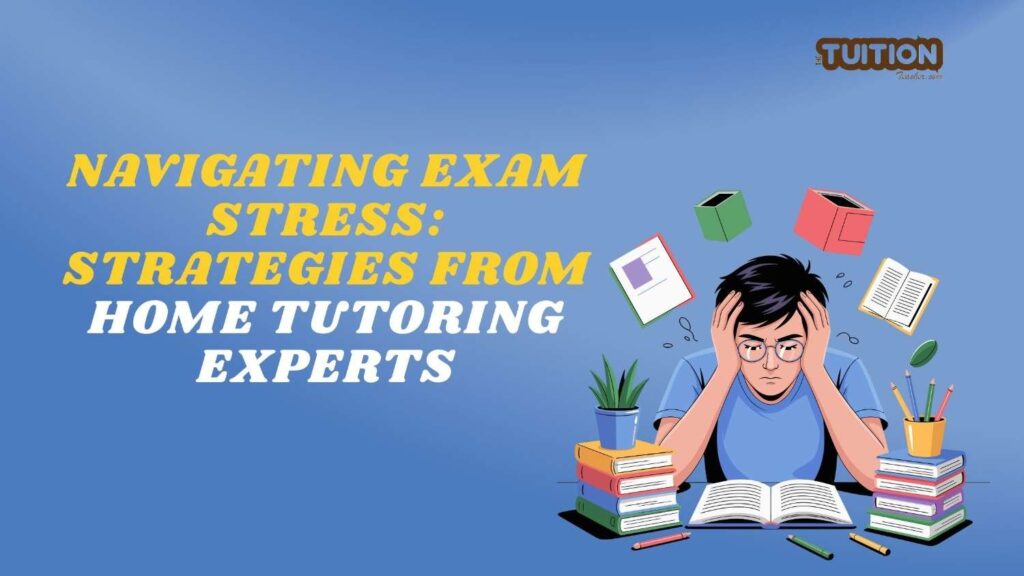
Exam stress isn’t just “pressure.” It’s your brain interpreting the exam as a threat. The goal isn’t to eliminate stress entirely, but to convert it into structure—clear planning, calmer revision, stronger recall, and steady confidence. This is a pattern Home Tutoring Experts observe year after year, and platforms like TheTuitionTeacher reinforce it in practice: students who follow a guided plan and structured practice system consistently outperform those who study for longer hours but without direction.
Why Exam Stress Feels So Real
Exam stress shows up in strange ways: headaches, sleep issues, irritability, stomach discomfort, overthinking, sudden forgetfulness, or even crying spells right before studying. Many students assume this means they’re “weak.” Home Tutoring Experts know it usually means something else:
- The syllabus feels bigger than the time left.
- The student is working hard but not seeing progress.
- Revision is random, so confidence doesn’t build.
- There’s fear of disappointing parents/teachers (or self).
- Past exams left a “memory of failure” that triggers anxiety.
Stress becomes harmful when it blocks action. But stress can also become useful—if it pushes you to plan, practice, and repeat.
A Home Tutoring Experts’ View: Stress Has Three Roots
Most exam stress comes from one (or more) of these:
1) Uncertainty
Students don’t know what to study first, what matters most, or how to revise.
2) Skill gaps
They’re “reading” but not able to solve questions, write answers, or recall under time pressure.
3) Emotional overload
Fear, comparison, parent expectations, or perfectionism hijacks focus.
A good home tutor doesn’t just teach chapters—they reduce uncertainty, fix skill gaps, and coach the emotional side of performance.
Strategy 1: Convert “Syllabus Fear” into a Map (The 30-Minute Reset)
When stress is high, the brain zooms out: “Everything is left.” So we zoom in.
Do this today (30 minutes):
- Write all subjects on one page.
- Under each, list chapters in three buckets:
- Green: confident
- Yellow: okay but needs revision
- Red: weak / avoided chapters
- Pick 2 Reds to rescue first (not all Reds).
Why it works: Stress reduces when the brain sees a plan. A plan turns fear into a sequence.
Strategy 2: Implement “Minimum Effective Review” (Avoid Constant Reading)
Home Tutoring Experts often notice this trap: students revise by reading notes repeatedly, but marks don’t improve.
A stronger method is Active Recall + Practice:
- Close the book.
- Ask yourself questions.
- Solve 10–20 targeted problems.
- Check mistakes.
- Repeat.
Simple rule:
If you can’t test yourself, you don’t truly know it yet.
Strategy 3: The 3-2-1 Daily Plan (A Tutor-Friendly Routine)
This is a routine many private home tutors use because it’s realistic and consistent.
Every day:
- 3 tasks: One big chapter/major topic, one medium topic, one quick revision
- 2 timed blocks: 25–40 minutes each (focused)
- 1 test moment: a mini test (10 questions or one writing answer)
The goal is not “study all day.” The goal is finish and feel progress.
Strategy 4: Fix the Most Common Stress Trigger—“I Forget Everything in the Exam”
Students often know the content at home but blank out in the hall. That’s not always lack of knowledge; it’s lack of retrieval practice under pressure.
Try this “Exam Hall Simulation” twice a week:
- Sit at a table.
- Put phone away.
- Set a timer.
- Do questions without help.
- Review mistakes like a coach, not like a critic.
Tutor insight: Students who do even 4–6 simulations usually feel a major drop in panic.
Strategy 5: Time Management That Doesn’t Feel Like Punishment
Time management fails when it’s too strict. It works when it’s flexible but consistent.
The “Anchor + Extras” schedule
- Anchors (must do): 2 study blocks + 1 revision
- Extras (bonus): additional practice, extra reading, extra test
This removes guilt. Even on a bad day, anchors protect momentum.
Strategy 6: Stop the Comparison Spiral (Marks Are Not Identity)
Exam stress becomes toxic when students attach self-worth to performance:
- “If I score low, I’m not smart.”
- “If I don’t top, I’m a failure.”
- “My friend is ahead; I’m finished.”
Home Tutoring Experts help students reframe:
- Marks measure current performance, not permanent potential.
- Improvement is a system, not a mood.
- Confidence is earned through small wins, not motivational quotes.
Micro-win idea: After each study session, write one line:
“Today I improved ____.”
It trains your brain to notice progress instead of panic.
Strategy 7: Sleep, Food, and Screens (The Hidden Study Tools)
This sounds obvious, but it’s the first thing students sacrifice. And then memory collapses.
Sleep
- Aim for a consistent sleep-wake time.
- Avoid heavy study right before bed; revise light notes or formulas.
Food
- Do not skip meals. Decreased blood sugar heightens anxiety and diminishes concentration
Screens
- If you can’t reduce screen time, schedule it.
Example: 20 minutes after 2 study blocks.
Tutor note: When students fix sleep and structure, they often need less study time to get better marks.
Strategy 8: How Parents Can Help Without Adding Pressure
Parents usually push because they care. But pressure often increases stress.
What helps:
- Ask process questions: “What’s your plan for today?” not “How much did you study?”
- Praise consistency, not just marks.
- Provide a calm environment and predictable routine.
What hurts:
- Comparing with other students.
- Bringing up worst-case scenarios repeatedly.
A good tutor can also guide parents on what to expect and how to support calmly during exam season.
Strategy 9: Learn How Marks Are Actually Awarded
Many students lose marks not because they don’t know the answer—but because they don’t present it well.
Home Tutoring Experts often focus on:
- Keyword usage
- Step-wise answers
- Neat structure (especially in science & maths)
- Introduction–body–conclusion format in theory answers
Tutor insight:
Once students understand how answers are evaluated, their fear drops sharply. Exams stop feeling random.
Strategy 10: Build a “Mistake Notebook” (A Game-Changer)
Top-performing students aren’t the ones who make fewer mistakes—they’re the ones who repeat fewer mistakes.
Ask students to maintain a simple notebook:
- One page per subject
- Only write:
- Repeated errors
- Confusing concepts
- Silly mistakes (calculation, signs, wording)
Revising this notebook before exams is far more powerful than revising entire books again.
When Home Tutoring Helps Most (And Why It Reduces Stress)
Home tutoring reduces stress because it adds:
- Clarity: what to study and how much
- Accountability: someone tracks progress weekly
- Skill-building: practice questions, writing, timed tests
- Confidence: mistakes are corrected early, not on the final exam
Most importantly, private home tutors can adapt to a student’s pace—something classrooms can’t always do.
What Home Tutoring Experts Observe Every Exam Season (Patterns That Repeat)
After working with thousands of students across boards and classes, Home Tutoring Experts notice something important:
Exam stress is rarely caused by the exam itself.
It’s caused by misalignment—between effort and results.
Here are the most common patterns tutors see:
- Students study long hours, but revision lacks direction
- Students understand concepts, but can’t express answers properly
- Students know formulas, but panic under time pressure
- Students are sincere, but don’t know what matters most for marks
This is where expert home tutoring changes outcomes—not by increasing pressure, but by reducing noise.
The Tutor Advantage: Why One-to-One Guidance Calms the Mind
In classrooms, teaching is collective. Exams, however, are individual. That gap creates stress.
A private home tutor bridges this gap by:
- Slowing down where the student needs it
- Speeding up where the student is already strong
- Explaining why marks are lost, not just what is wrong
- Helping students think like an examiner
Stress reduces when uncertainty disappears.
That clarity is one of the biggest benefits of home tutoring.
Why TheTuitionTeacher Can Be a Strong Choice in Lucknow
If you’re searching for trusted home tutoring solutions, the difference is not “tuition vs no tuition.” The difference is quality and fit.
Here’s what students and parents typically want:
- Qualified, experienced tutors
- One-to-one attention
- Tutors for all classes and subjects
- Reliable matching and support
- Local availability (especially important for home tuition)
TheTuitionTeacher highlights exactly this kind of support—connecting learners with qualified, experienced private home tutors in Lucknow for all classes and subjects, backed by a large tutor network (over 120,000 tutors, as shared).
If you’re specifically looking for home tutors in Lucknow, local matching matters—commute, schedule reliability, and familiarity with boards/schools.
👉Join TheTuitionTeacher as a Tuition Teacher or Home Tutor
A Practical 7-Day “Calm + Score” Plan (Used by Home Tutoring Experts)
Use this as a starter plan. Repeat weekly.
Day 1: Audit + Plan
- Bucket chapters (Green/Yellow/Red)
- Pick 2 Reds to rescue this week
Day 2: Rescue Red #1
- Concepts + 20 practice questions
Day 3: Writing & Timed Practice
- 1 timed section + error review
Day 4: Rescue Red #2
- Concepts + practice + quick revision
Day 5: Mixed Revision
- 30–45 minutes per subject (active recall)
Day 6: Mock Test Lite
- Partial test, focus on weak areas
Day 7: Consolidation
- Formula sheet, key notes, common mistakes list
This plan works because it balances learning, practice, and confidence.
How a Large Tutor Network Improves Tutor Quality
One underrated factor in choosing a home tutoring solution is scale.
A large tutor network allows:
- Better matching based on subject + class + board
- Replacement options if the fit isn’t right
- Access to specialists for higher classes or competitive exams
This flexibility matters when exams are close and time is precious.
Parent Checklist: Are You Supporting or Stressing?
Parents play a silent but powerful role during exams.
Supportive actions:
- Maintain a calm home environment
- Trust the study plan
- Encourage breaks without guilt
- Focus on effort and consistency
Stress-amplifying actions:
- Daily comparison with other students
- Repeated reminders of consequences
- Overloading with extra resources
- Emotional reactions to mock-test scores
A good home tutor often helps parents recalibrate expectations too.
Follow TheTuitionTeacher on social media for updates, tips, and tutor opportunities:
Instagram | YouTube | Facebook | LinkedIn | Twitter (X)
Final Thought
Exam stress is not proof that you’re unprepared—it’s proof that the exam truly matters to you. The real shift happens when students stop battling stress emotionally and start responding to it practically through clear planning, focused practice, timely feedback, and small daily wins.
If you’re looking for reliable and trusted home tutoring support in Lucknow, Home Tutoring Experts often point toward structured systems like TheTuitionTeacher, which connects students with qualified, experienced private home tutors who match their exact academic needs—bringing consistency, accountability, and confidence exactly when it matters most.